
 Ελληνικά
 English
 Español
Global system of organizations
Many clients ask us about a "global" trademark. There is no such thing as a truly "worldwide" registration. Registering a trademark at the international level is not a single, unified procedure, but rather a mosaic of dozens of different authorities, legal frameworks and requirements. Each country or regional organization operates with its own examination system, its own deadlines and its own way of assessing distinctiveness. This means that the strategy for protecting a brand changes significantly depending on the market it targets. In Europe there is a single organization, the EUIPO, which covers 27 member states. In Asia, by contrast, every major country operates an entirely separate system - from China and Japan to India, South Korea and Vietnam. Africa combines two large regional organizations (OAPI and ARIPO) with many countries that remain independent. In the Americas, each country has its own procedure, from the USPTO in the United States to the national systems of Brazil, Argentina, Mexico and Canada.
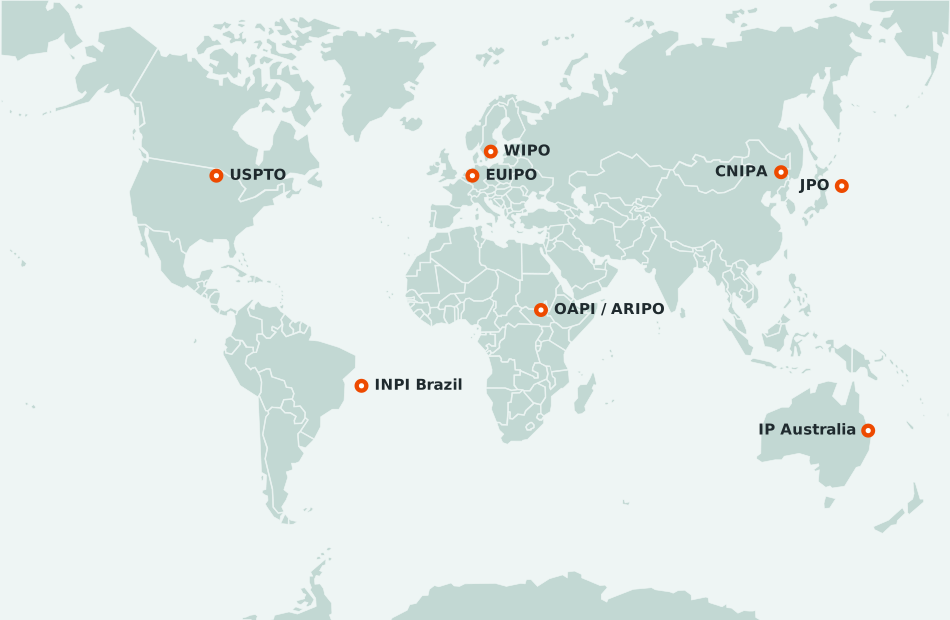
This complexity does not exist to make things harder for businesses; it exists because each market protects its own business environment differently. For the owner of a brand, however, it means that choosing the right registration route is often crucial to the security and value of the trademark. The map we have created serves as a simple orientation guide: it shows the largest organizations, the most important markets and the main entry points to global protection. It does not replace proper research or detailed due diligence - but it helps make clear just how different the procedures are from region to region, and why the right strategy is the most important step before any filing. To help you better understand the landscape, we have divided trademarks into 3 categories: 1) Group / Regional Systems 2) Significant due to market size 3) Indicative Individual Systems
To help you understand the web, we split marks into 3 categories:
- Group / Regional Systems
- Significant due to market size
- Notable Individual Systems

Group / Regional Systems
Group / Regional Systems include organizations that offer protection in many countries through a single, central procedure. They are the most efficient options for broad geographic coverage, as they consolidate the paperwork and reduce administrative costs. However, these systems do not all work the same way; they fall into two categories: Unitary Systems (EUIPO type): With a single application you automatically obtain protection in all member states of the union simultaneously (e.g. European Union, Eurasia). It is an "all or nothing" system. Selection Systems (WIPO type): The application is central, but works as a "bridge". It allows you to choose specifically which countries you want to cover and you pay according to your selection.
WIPO - International
Headquarters: Geneva, Switzerland. Offers international registration through the Madrid System for dozens of countries. (Country selection system)
EUIPO - European Union
Headquarters: Alicante, Spain. A single application covers all 27 EU countries.

BOIP - Benelux
Headquarters: The Hague, Netherlands. Joint registration for Belgium, the Netherlands and Luxembourg.

ARIPO - East & Southern Africa
Headquarters: Harare, Zimbabwe. Regional system for 20 mainly English-speaking countries of Africa. (Country selection system)

OAPI - West & Central Africa
Headquarters: Yaoundé, Cameroon. Unitary protection for 17 mainly French-speaking African countries.
EAEU - Eurasian Economic Union
Headquarters: Moscow, Russia (Eurasian Commission). A new unitary system offering joint protection in Russia, Belarus, Kazakhstan, Armenia and Kyrgyzstan.

Significant due to market size
These countries carry particular weight due to the enormous volume of trademarks, strong economic activity and high registration requirements. Although they operate national systems, they are pillars of the global market and often represent a strategic priority for every international brand.
USPTO - United States
Headquarters: Washington D.C. The largest and most competitive trademark market in the world.

CNIPA - China
Headquarters: Beijing. The country with the largest number of applications and decisive for international brands.

UKIPO - United Kingdom
Headquarters: Newport. An independent system after Brexit, it remains one of the most important markets in Europe.
JPO - Japan
Headquarters: Tokyo. A strict examination system in one of the strongest high-tech economies.
CGPDTM - India
Headquarters: Mumbai. A rapidly growing market with an enormous consumer base.
KIPO - South Korea
Headquarters: Daejeon. A key market for technology, electronics, fashion and innovation.

DGIP - Indonesia
Headquarters: Jakarta. The largest economy in Southeast Asia and a G20 member, with an enormous domestic market.
INPI Brazil - Brazil
Headquarters: Rio de Janeiro. The largest market in South America.
CIPO - Canada
Headquarters: Gatineau. A stable economy with strong intellectual property protection.
IP Australia - Australia
Headquarters: Canberra. A key market for the Asia-Pacific region, with a strict regulatory framework.
IMPI - Mexico
Headquarters: Mexico City. A crucial market for North America and the 2nd strongest economy in Latin America.
TURKPATENT
Headquarters: Ankara. Straddling Europe and Asia, it holds one of the highest numbers of applications worldwide.

Notable Individual Systems
These are countries that do not belong to regional organizations and maintain autonomous national registration systems. Worldwide there are more than 190 national trademark offices - which is why choosing the right coverage strategy is critical.